
Why the Age of Three Is the Perfect Time for Brain Development Toys
Brain development toys for 3 year old children are one of the smartest investments you can make in your child’s early learning — and the right picks make a real difference.
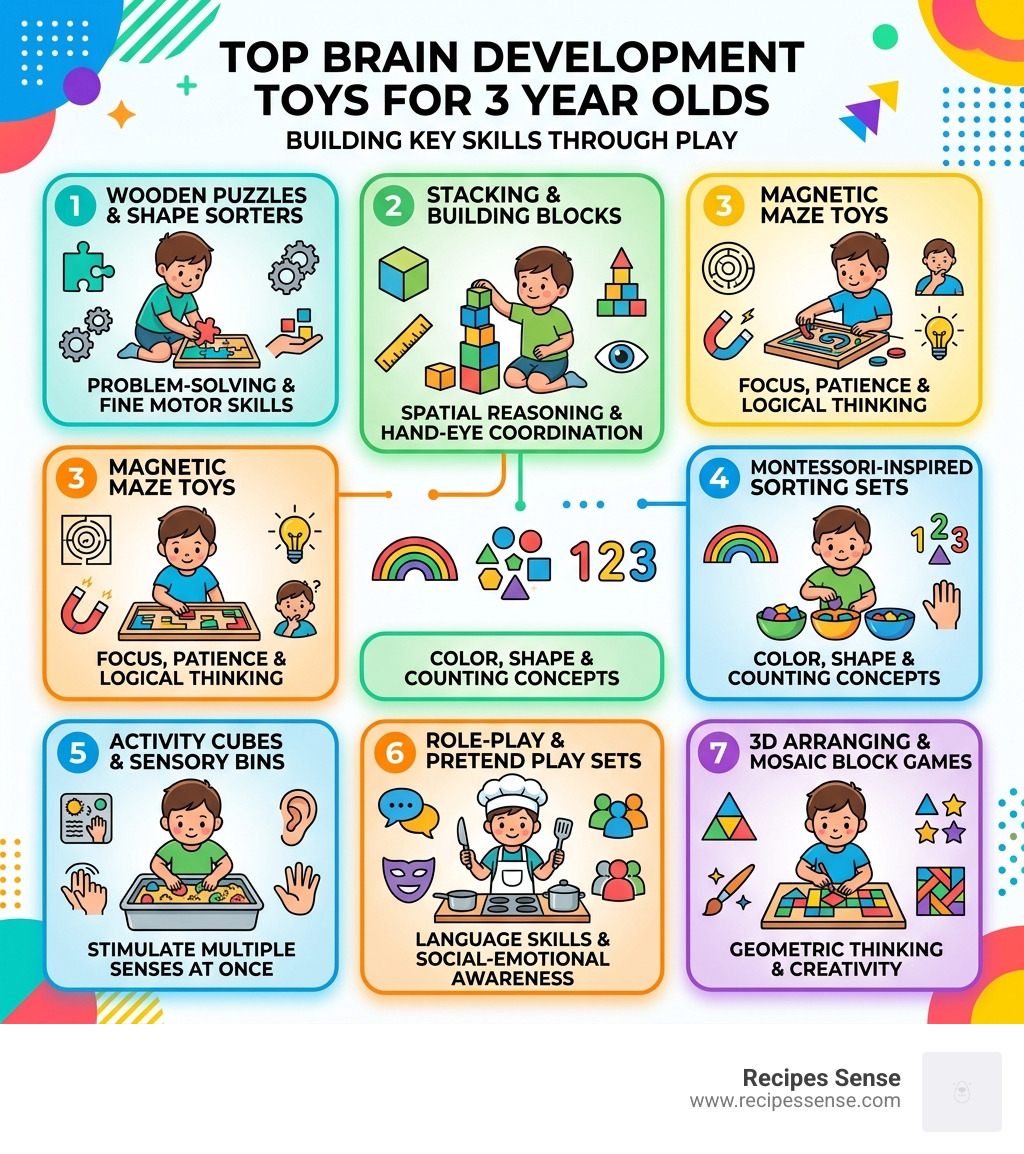
Here are the best types of brain development toys for 3-year-olds:
- Wooden puzzles and shape sorters — build problem-solving and fine motor skills
- Stacking and building blocks — develop spatial reasoning and hand-eye coordination
- Magnetic maze toys — strengthen focus, patience, and logical thinking
- Montessori-inspired sorting sets — teach color, shape, and counting concepts
- Activity cubes and sensory bins — stimulate multiple senses at once
- Role-play and pretend play sets — grow language skills and social-emotional awareness
- 3D arranging and mosaic block games — support geometric thinking and creativity
Age three is a remarkable window for learning. Children at this stage are asking endless questions, following simple storylines, and starting to understand counting and basic shapes. Their brains are forming connections at a rapid pace.
The problem? Not all toys take advantage of this window. Many simply entertain — they don’t build anything lasting.
That’s what separates a good toy from a great one. The best brain development toys for this age combine hands-on play with real cognitive challenges. They’re the kind of toy a busy parent can hand to a child and feel genuinely good about.
Whether you have five minutes or an afternoon, the right toy does the heavy lifting — turning playtime into learning time without any extra effort from you.
Why Brain Development Toys are Essential for Preschoolers
When we talk about brain development toys for 3 year old toddlers, we are really talking about building the foundation for a lifetime of learning. At this age, a child’s brain is twice as active as an adult’s. Every time they grasp a wooden block or solve a puzzle, they are strengthening neural pathways that help with everything from math to emotional regulation.
We believe these toys are essential because they target several key areas simultaneously:
- Fine Motor Skills: Using small muscles in the hands and fingers is a precursor to writing. Toys like the Mosaic 3D Wooden Arranging Game– HABA USA require precise movements that prepare little hands for school.
- Problem-Solving: When a toddler realizes a square peg won’t fit in a round hole, they are practicing logic. This builds resilience and the ability to think critically.
- Hand-Eye Coordination: Activities that involve “pinching,” “stacking,” or “threading” help the eyes and hands work together.
- Cognitive Stimulation: Brain toys challenge children to categorize, count, and recognize patterns, which are the building blocks of early literacy and numeracy.
- Sensory Perception: Tactile play with materials like wood or textured “Playfoam” provides sensory feedback that digital screens simply cannot replicate.
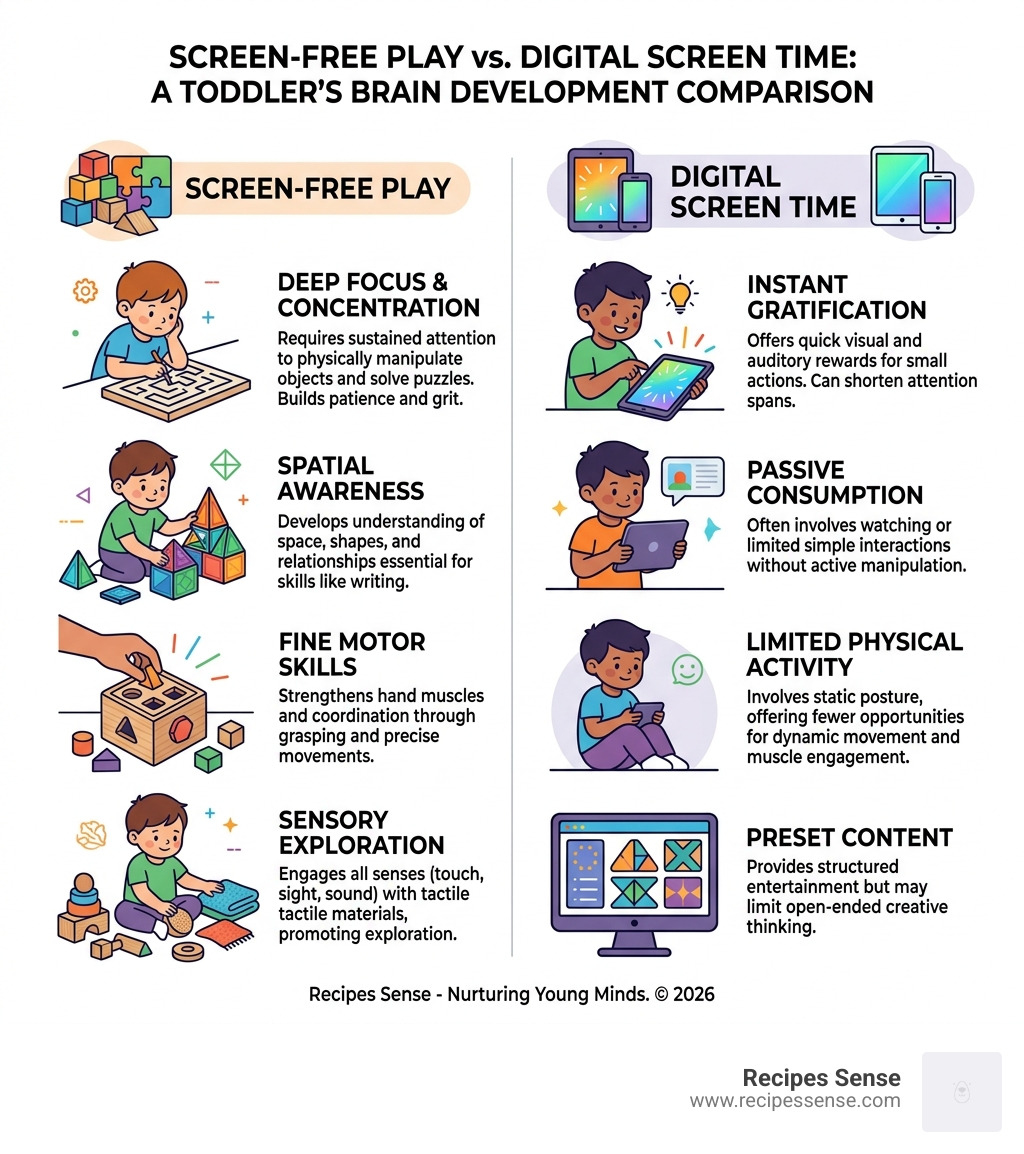
By May 2026, we’ve seen a massive shift toward “screen-free” learning. Parents are increasingly looking for toys that encourage “deep focus” rather than the instant gratification of a tablet. These physical toys require patience, which is perhaps the most important “brain skill” a preschooler can learn.
Key Developmental Milestones at Age Three
To choose the right brain development toys for 3 year old children, we first need to understand what they are capable of. Three is often called the “Magic Age” because children transition from being “toddlers” to “preschoolers.” They are becoming more independent, their language is becoming conversational, and they are beginning to understand social cues like compassion.
Common milestones we see at this age include:
- Drawing simple shapes like circles or crosses.
- Following two-to-three-step instructions.
- Understanding the concept of “mine” and “theirs” (even if they don’t always want to share!).
- Recognizing and naming basic colors and shapes.
- Understanding the beginning of counting (1, 2, 3…).
When selecting toys, it helps to think about whether the play is “open-ended” or “close-ended.” Both are vital for a balanced brain.
| Play Type | Benefits for 3-Year-Olds | Example Toys |
|---|---|---|
| Open-Ended | Fosters imagination, creativity, and “limitless” thinking. | Wooden blocks, play dough, magnetic tiles. |
| Close-Ended | Builds a sense of accomplishment, focus, and logic. | Puzzles, shape sorters, matching games. |
Cognitive Milestones and Brain Development Toys for 3 Year Old
At age three, cognitive development takes a giant leap forward in the form of “sequential thought.” This is the ability to understand that one action leads to another. Toys like the MagnaMaze™ Montessori Brain Adventure are perfect for this. By using a magnetic wand to navigate beads through a maze, children must plan their route, which builds concentration and visual memory.
This type of play is often referred to as “school readiness.” It’s not just about learning letters; it’s about training the brain to stay focused on a task for 15, 20, or even 30 minutes. Research shows that children who engage in hands-on tactile play often have better “reading readiness” because they have developed the spatial intelligence required to distinguish between different letter shapes.
Building Spatial Intelligence with Brain Development Toys for 3 Year Old
Spatial intelligence is the ability to visualize shapes and how they fit together in a 3D space. This is a core skill for future success in STEM (Science, Technology, Engineering, and Math).
We recommend toys like Creative Stones 3D Arranging Blocks | HABA USA. These aren’t just your average blocks; they use geometric forms to challenge a child to move from 2D patterns to 3D structures. By experimenting with symmetry and balance, a 3-year-old begins to understand the physical laws of the world—like gravity and structural integrity—all while they think they’re just building a “cool tower.”

Top Categories of Brain Development Toys for 3 Year Old
With so many options on the market, it can be overwhelming to choose. Based on industry data from 2026, here are the categories that deliver the highest educational value:
- Montessori-Inspired Toys: These focus on self-directed activity and hands-on learning. The goal is to let the child discover the “answer” themselves. Think of “Bee Boxes” where kids use tweezers to match bees to hives—this builds patience and the “pincer grasp” needed for holding a pencil.
- STEM Foundations: You might think 3 is too young for “coding,” but “screen-free coding” is a huge trend. Using toys like robot mice that follow physical arrows helps children learn logic and directional commands.
- Sustainable Wooden Toys: Brands like Melissa & Doug and HABA emphasize wood because it’s durable and provides a natural sensory experience. Plus, with commitments like planting 10 million trees by 2030, these toys are better for the planet.
- Magnetic Mazes and Puzzles: These are excellent for “quiet time.” They keep the beads sealed under a cover, making them mess-free and perfect for travel while still providing a “video-game-like” engagement.
- Sensory Play: Toys like “Playfoam” or sand kits allow children to explore textures, which calms the nervous system and improves focus, especially for children with sensory processing needs or autism.
How Specific Toys Build Critical Skills
Let’s look at how a few classic toys actually “work” the brain. It’s fascinating to see the science behind the fun!
- Shape Sorters: These are the ultimate logic trainers. A child has to observe the shape, rotate it in their hand (fine motor), and match it to the hole (spatial reasoning). If it doesn’t fit, they have to try again (resilience).
- Stacking Blocks: Beyond just building towers, stacking helps children understand “classification.” They might group blocks by color, size, or shape, which is an early math skill.
- Activity Cubes: These often have five or six different activities in one. This encourages “exploration” and keeps a child’s attention longer as they move from a clock face to a bead maze to a spinning gear.
- Magnetic Wand Mazes: As seen in the MagnaMaze™ Montessori Brain Adventure, these toys require a steady hand. If a child moves too fast, they “lose” the bead. This teaches them that slow, deliberate movements lead to success.

Choosing Safe and Sustainable Toys for Toddlers
As we curate gifts at Recipes Sense, we prioritize safety and sustainability. When you are looking for brain development toys for 3 year old children, keep these “Safety Checkpoints” in mind:
- Materials: Opt for sustainably sourced woods like beech or rubberwood. These are often treated with water-based, solvent-free stains rather than harsh oil paints.
- Chemical-Free: Look for labels that mention “formaldehyde-free glue” and “organic pigments.” Since 3-year-olds occasionally still “taste” their toys, non-toxic finishes are a must.
- Durability: A good brain toy should be an heirloom. Wooden toys can survive being dropped, stepped on, or thrown, whereas plastic often cracks and creates sharp edges.
- Safety Certifications: Ensure toys meet US (ASTM) or European (CE) safety standards. For magnetic toys, ensure the magnets are securely encased or sealed under heavy-duty acrylic.
Cleaning these toys is also simple. For wooden items, we recommend a cloth dampened with warm water and a tiny bit of vinegar. Never submerge wooden toys in water, as it can cause the wood to swell and the paint to peel!
Frequently Asked Questions about Preschool Learning
We know you have questions! Here are some of the most common things parents ask us about maximizing their child’s playtime.
How do screen-free toys compare to digital alternatives for brain development?
Digital apps often rely on “instant gratification”—bright lights and sounds that reward every tap. This can actually shorten a child’s attention span. In contrast, physical brain development toys for 3 year old kids require “deep focus.” A child has to physically manipulate an object to get a result. This builds “grit” and patience. While a tablet can teach a child to recognize the letter “A,” a magnetic maze or a wooden puzzle teaches them the spatial awareness to eventually write that letter.
What are the best affordable brain development toys under $50?
You don’t have to spend a fortune to build a better brain! Many of the most effective toys are very budget-friendly.
- Stacking Sets: Many high-quality wooden sets are available for $15-$25.
- Reusable Books: Water-based “Magic Books” are great for doodling without the mess and cost under $20.
- Sorting Sets: Simple counting bears or fruit-sorting pies usually fall in the $25-$40 range.
- Bundles: Look for “Play Packs” that combine three or four smaller items for a discounted price, often around $45.
How can parents incorporate these toys into daily routines?
The key is not to make it feel like “school.”
- Quiet Time: Introduce a magnetic maze or a puzzle during the hour after lunch to help the child wind down.
- Co-Play: Spend 10 minutes building a tower together. Use this time to narrate what you’re doing (“I’m putting the blue square on top of the red triangle”). This boosts language skills.
- Independent Exploration: Leave a few open-ended toys, like blocks or “Creative Stones,” in a reachable basket. This encourages the child to initiate play on their own, building independence.
Conclusion
Choosing the right brain development toys for 3 year old toddlers is about more than just keeping them busy; it’s about giving them the tools to explore, understand, and master the world around them. From the tactile satisfaction of a wooden block to the logical challenge of a magnetic maze, these toys turn every “playtime” into a moment of growth.
At Recipes Sense, we believe in the power of sensory appeal—”Sentidos despertos, paladar satisfeito.” Whether you are looking for a gift that inspires a future architect or a utility that makes daily learning easier, we focus on quality products that blend lifestyle with education. We invite you to explore our curated selection of toys and gifts that help every child thrive, one playful moment at a time.
